|
 The
Creation : The
Creation :
By Peter Austen
Icefields
are satisfying but rock climbing is wonderful too. I was elated. We
had just finished a fantastic climb after many days of intermittent
effort over a 3 year period. Lying in the warm shallow water of Stuart
Lake, near Fort St.James, British Columbia, looking back up at the 1000
foot limestone prow we had just climbed, a name came to me: "the Creation."
This was in keeping with the tradition of religious names on this huge
limestone cliff on Mount Pope in central British Columbia. We had "created"
this climb. It was not a straightforward line as for instance a long
crack or a rock chimney would be. We had pieced every bit of it together
to make progress up the cliff. The grey cliff resembled the inclined
forehead of an elephant, and when you stood underneath it was like being
under the prow of a ship in dry dock.
We were
400 feet up on a hot day in June. Timo, a Finnish friend, was 30 feet
above me and struggling on a blank looking wall. He tried to move up,
the rope snaking out jerkily. I saw his leg start to shake- the Elvis
sewing machine, caused by cramping in the calf muscle. There was no
protection between me and him apart from the anchor point, or belay
to which I was tied. The rock was too blank. There were no cracks or
holes of any kind. We could not use normal protection or camming devices
called "friends" or wedges or pitons. I saw his fingers clutch some
tiny spikes on the left and his feet scrabble on tiny scoops, called
smears, in the rock. "Vatch me ," Timo shrieked.
 An
eagle wheeled leisurely underneath me, happy, secure and in total control
of its environment. One of Timo's hands blew off the rock. I was fearing
the worst: a 60 foot fall with no protection between us. He would fall
past me and the impact forces on the rope and me would be enormous.
If the rope ran over any edges it would probably break. I silently prayed
at high speed. Anyone seeing my lips moving would have thought I was
freezing cold. I was at least as scared as Timo. He almost slipped,
lunged downwards with a big step and his foot lodged in a tiny hole.
I saw him taking deep breaths of relief. He climbed over to easier ground
and we retreated that day. An
eagle wheeled leisurely underneath me, happy, secure and in total control
of its environment. One of Timo's hands blew off the rock. I was fearing
the worst: a 60 foot fall with no protection between us. He would fall
past me and the impact forces on the rope and me would be enormous.
If the rope ran over any edges it would probably break. I silently prayed
at high speed. Anyone seeing my lips moving would have thought I was
freezing cold. I was at least as scared as Timo. He almost slipped,
lunged downwards with a big step and his foot lodged in a tiny hole.
I saw him taking deep breaths of relief. He climbed over to easier ground
and we retreated that day.
When we
returned we had expansion bolts with us. You drill a small hole 2 inches
deep and insert a bolt which expands when you unscrew it. Then you insert
a snaplink or carabiner and pass the rope through it. You may do this
every 6 feet or so if there is no other protection. The third pitch
was a curving crack which took pitons and nuts really well. The top
part of this was a layback - a strenuous movement whereby you put feet
against the wall and hands pull back in the crack. The opposing pressures
allow you to move up.
 Then
came another very hard section. Timo hung on somehow and hand drilled
2 bolts over a 3 hour period. The wall steepened up and there were no
handholds to hang on to in order to place bolts. We retreated and came
back the week after to rappel down the wall and place bolts while hanging
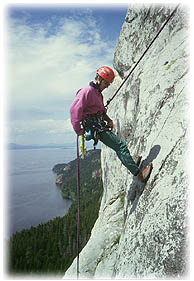
on the rope. The 1000 foot drop licking at your boot soles was scary
but stimulating. When you rope down a wall a strange type of unreality
overcomes you. Going over the edge was worse than the time I had 3 teeth
taken out by a sadistic school dentist akin to the one in "Little Shop
of Horrors."- the one where Steve Martin sings while he extracts teeth.
Perhaps this unreality results from a high safety concentration level.
This sharpens the mind. Most of the time, in everyday situations a person
goes around with a complacency that only gets shaken if you are run
over by a truck or happen to be in an earthquake. Then
came another very hard section. Timo hung on somehow and hand drilled
2 bolts over a 3 hour period. The wall steepened up and there were no
handholds to hang on to in order to place bolts. We retreated and came
back the week after to rappel down the wall and place bolts while hanging
on the rope. The 1000 foot drop licking at your boot soles was scary
but stimulating. When you rope down a wall a strange type of unreality
overcomes you. Going over the edge was worse than the time I had 3 teeth
taken out by a sadistic school dentist akin to the one in "Little Shop
of Horrors."- the one where Steve Martin sings while he extracts teeth.
Perhaps this unreality results from a high safety concentration level.
This sharpens the mind. Most of the time, in everyday situations a person
goes around with a complacency that only gets shaken if you are run
over by a truck or happen to be in an earthquake.
Another
hot day in late June saw us back at the high point. Timo was anchored
in the middle of the wall and I took over the lead. As I moved left
and tensioned across the drop below me grew to close to 1000 feet. Sailboats
moved serenely across the lake. Why was I struggling up here when I
could have done much easier activities. My rewards, I believe, are greater.
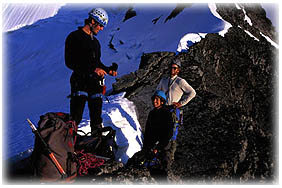 I
stretched over and thought I was on the ledge we had eyed for days.
There was a 6 foot wide loose block in the way. It was detached from
the rock and I had no idea what held it there. I estimated its weight
at 1000 pounds or more and I had to stand on it. I tiptoed gingerly
on to it and transferred my weight. It moved but did not cut loose.
I collapsed on the ledge like a wet fish, sweaty and wasted. Timo came
over fast, as if he was barefoot on a hot beach. I
stretched over and thought I was on the ledge we had eyed for days.
There was a 6 foot wide loose block in the way. It was detached from
the rock and I had no idea what held it there. I estimated its weight
at 1000 pounds or more and I had to stand on it. I tiptoed gingerly
on to it and transferred my weight. It moved but did not cut loose.
I collapsed on the ledge like a wet fish, sweaty and wasted. Timo came
over fast, as if he was barefoot on a hot beach.
"Zat vas
vild and hard," he said, panting heavily. The last pitch went straight
up a vertical crack, 2 inches wide for 40 feet. Right at the top was
a big hole to lovingly sink the hand into and lurch over the top. It
was right out there, strenuous but enjoyable. We lay on the top and
basked in the sun. There are many futuristic problems left on the overhanging
walls of Mount Pope. We will leave the really horrific ones to a more
talented generation.
|