|
|
|
Step 1
:
Place the hook into the jaws of the vise and weight if desired. Cover the hook shank with tying thread.
|
It's hard to believe but another spring and summer has past and fall is here. Fall is perhaps my favorite time of the year to fish. The days are crisp with a hint of the oncoming winter. Mother Nature has been running around painting the countryside beautiful shades of red, yellow and orange. Gone are the crazed crowds of early spring and summer. Small trout have become wiser and bigger while the spawners of the spring have had a chance to clean up. Fall is the time for trophy trout. It is a magical time of the season.
|
|
|
Step 2
:
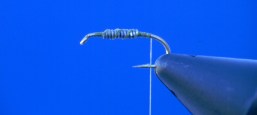
Tie in the copper wire rib. Advance the tying thread to the front of the hook. Tie the shellback so the majority of the material points out in
front
of the eye.
|
The hatches of the season are over. Trout once again turn their attention to staple food sources such as leeches, immature dragons and damsels, bloodworm and scuds. Fishing imitations of any of these menu items catches fish. Scuds however are one of the most prominent menu items during the fall season. It is rare to find scuds missing from any stomach sample. Next to chironomids these crustaceans are the most important food source for trout in stillwaters. These underwater rabbits are fertile little creatures. A pair of scuds is capable of producing 7 broods of offspring in a single season totaling over 20,000 scuds. Now that's productivity. Rich in carotene scuds are the reason for the beautiful pink flesh of the Kamloops Rainbow. There are two families of scuds in British Columbia, Gammarus and Hyallela. Of the two Hyallela are the most widespread. Gammarus on the other hand require waters rich in calcium for the development of their exoskeletons. The main distinguishing feature between the two families is size. Gammarus are large reaching over 5/8ths of an inch under ideal conditions. Hyallela on the other hand are tiny, seldom exceeding 1/8th of an inch. You can guess which family trout seem to prefer. The pint size Hyallela much to the chagrin of many anglers.
|
|
|
Step 3
:
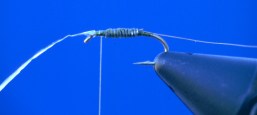
Move the tying thread to the rear of the hook. Form a dubbing loop and dub a rough body forward to the eye of the hook. Be careful not to crowd the head area.
|
The Pearl Shrimp is one of four patterns I toss at stillwater trout and is nothing more than a variation on the venerable Baggy Shrimp. Observing scuds in my aquariums I noticed that they sometimes exhibit a shinny luminance. Based upon this observation I set about modifying my Baggie Shrimp patterns to mimic this quality. The modifications did not take long. Go to any craft store and you should find a material called Paper Twist. It is available in a number of colors I stick with pearlescent, as it is adaptable to just about any pattern. Paper Twist looks like a twisted rope of Mylar and is sold on large cardboard rolls. Ten dollars should buy a life time supply. Begin by unraveling a small length of Paper Twist to its full width. Take a straight edge and a sharp knife or razorblade and cut a number of 1/8 inch wide strips. In about 5 minutes you will have enough strips for a ton of flies. Paper Twist also makes great wings on adult damsel patterns.
|
|
|
Step 4
:
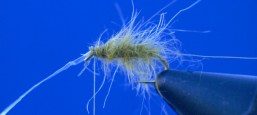
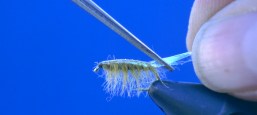
Pull the shellback material back across the top of the body and hold it in place. Wind the rib forward in open wraps securing the shellback material in place while providing segmentation. Tie off and then twist and break the excess ribbing material.
|
For my scud patterns I use two hook styles, the Tiemco 2457 heavy wire scud hook and the 3769 standard wet fly hook. Keep in mind scuds swim with their bodies nearly straight. Only their telsun at the rear hangs down. Sharply curved scuds are either dead, resting, falling or feeding. Try to imitate mobile scuds. If I am going to weight my scud pattern I stick with the straight shank of the 3769. The 2457 has a slight hump to it and when weighted the keel effect of the lead wire substitute tends to roll the hook upside down. Once I have decided on hook style I begin by attaching a rib of either fine copper or gold wire. Secure the wire in place then advance the thread to the hook eye. Take a strip of paper twist and tie it in place at the eye of the hook so the majority of the strip points out in front of the fly. At this point the pattern should look like it has two long tails at either end. I use a dubbing loop to form a rough, shaggy body. My favorite dubbing mixes include natural seal's fur and Arizona Fly Fishing Scud Blends. Blending colors is a great idea, just remember the combinations. A 50/50 mix of yellow and olive is a great fall color, as are dirty yellow and olive. Remember to let the color of the local scuds be your guide.
|
|
|
Step 5
:
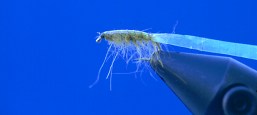
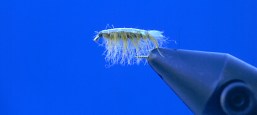
Roughen the body using either a Velcro comb or bodkin. Trim the dubbing fibers even with the bottom of the hook point to simulate the legs of the scud. Cut the shellback on a 30 degree angle away from the body forming a tail that resembles the telsun of the scud.
|
Turning over rocks and logs in the shallows is a great place to find scuds and other trout tidbits. Once the body is complete pull the pearlescent shellback strip back over the body and hold it in place. Wind the ribbing forward to secure the body while providing segmentation. Tie of the rib, build a neat head and whip finish. Trim the remainder of the pearlescent strip on a 30 degree angle away from the fly to form a small tail imitating the scud's telsun.
Most anglers including some rather famous ones don't like fishing scuds. Some contend that throwing a pattern amongst the zillions of others is a waste of time but if that was the case why would we fish chironomids. Others don't feel confident fishing a size 14 or 16 scud pattern but once again we wouldn't think twice about fishing a chironomid of the same size. For my scud fishing I prefer either a floating line and along leader 15 feet or better, or a slow sinking line such as the Stillwater or intermediate coupled with a 9 to 12 foot leader. Allow time for the fly to sink and inch it back using an erratic retrieve to imitate the random manner in which scuds swim. During the fall fish tight to shore you will be surprised how shallow fish will forage during this time. Often with barely enough water to cover their backs.
|
|
|
Step 6
:
Build a neat head, whip finish and apply head cement.
|
The Pearl Shrimp
- Hook: Tiemco 2457 or 3769 #8-#16
- Thread: Olive 8/0
- Rib: Fine Copper Wire
- Shellback: Pearlescent Strip 1/8" Wide
- Body: Seal's Fur or Synthetic Dubbing Color to Suit

|