Basic
Wilderness Survival Skills
The
advances in the development of outdoor clothing, equipment,
emergency food and techniques have been growing rapidly
in recent years. For those beginners interested in
using the outdoors there is unlimited information
on wilderness survival skills and equipment available.
However, experience is the best teacher in any outdoor
situation and your reaction in a wilderness survival
situation depends on your education. Always keep in
mind that it can happen to you. Those who are mentally
and physically prepared to survive are more likely
to do so. To deal with an emergency situation one
must be able to make decisions, improvise and remain
calm.
Fear
- For anyone faced with a wilderness emergency survival
situation, fear is a normal reaction. Unless an emergency
situation has been anticipated, fear is generally
followed by panic then pain, cold, thirst, hunger,
fatigue, boredom and loneliness. It is extremely important
to calmly assess the situation and not allow these
seven enemies to interfere with your survival.
Pain
- Pain may often be ignored in a panic situation.
Remember to deal with injuries immediately before
they become even more serious.
Cold
- Cold lowers the ability to think, numbing the body
and reducing the will to survive. Never allow yourself
to stop moving or to fall asleep unless adequately
sheltered.
Thirst
- Dehydration is a common enemy in an emergency situation
and must not be ignored. It can dull your mind, causing
you to overlook important survival information.
Hunger
- Hunger is dangerous but seldom deadly. It may reduce
your ability to think logically and increase your
susceptibility to the effects of cold, pain and fear.
Fatigue
- Fatigue is unavoidable in any situation so it is
best to keep in mind that it can and will lower your
mental ability. Remember that in an emergency situation
this is often the bodies way of escaping a difficult
situation.
Boredom
& Loneliness - These enemies are quite
often unanticipated and may lower the mind's ability
to deal with the situation.
HOW
TO:
Build a Fire
Building a fire is the most important task when
dealing with survival in the wilderness. Be sure to
build yours in a sandy or rocky area or near a supply
of sand and water as to avoid forest fires. The most
common mistakes made by those attempting to build
a fire are: choosing poor tinder, failing to shield
precious matches from the wind and smothering the
flames with too large pieces of fuel. The four most
important factors when starting a fire are spark -
tinder - fuel - oxygen.
The
most common ways to create spark are:

1.
Waterproof, strike-anywhere matches are your best
bet. Matches may be water-proofed by dipping them
in nail polish. Store your matches in a waterproof
container.
2.
A cigarette lighter is also a good way to produce
a spark, with or without fuel.
3.
The flint and steel method is one of the oldest and
most reliable methods in fire starting. Aim the sparks
at a pile of dry tinder to produce a fire.
4.
The electric spark produced from a battery will ignite
a gasoline dampened rag.
 5.
Remove half of the powder from a bullet and pour it
into the tinder. Next place a rag in the cartridge
case of the gun and fire. The rag should ignite and
then may be placed into the tinder. 5.
Remove half of the powder from a bullet and pour it
into the tinder. Next place a rag in the cartridge
case of the gun and fire. The rag should ignite and
then may be placed into the tinder.
6.
Allow the suns rays to pass through a magnifying glass
onto the tinder.
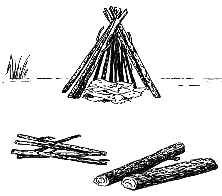
Dry
grass, paper or cloth lint, gasoline-soaked rags and
dry bark are all forms of tinder. Place your tinder
in a small pile resembling a tepee with the driest
pieces at the bottom. Use a fire starter or strip
of pitch if it is available.
It
is important to keep in mind that smaller pieces of
kindling such as, twigs, bark, shavings and gasoline,
are necessary when trying to ignite larger pieces
of fuel. Gather fuel before attempting to start your
fire. Obviously dry wood burns better and wet or pitchy
wood will create more smoke. Dense, dry wood will
burn slow and hot. A well ventilated fire will burn
best.
 Build a Shelter
A small shelter which is insulated from
the bottom, protected from wind and snow and contains
a fire is extremely important in wilderness survival.
Before building your shelter be sure that the surrounding
area provides the materials needed to build a good
fire, a good water source and shelter from the wind.
Wilderness
shelters may include:
1.
Natural shelters such as caves and overhanging cliffs.
When exploring a possible shelter tie a piece of string
to the outer mouth of the cave to ensure you will
be able to find your way out. Keep in mind that these
caves may already be occupied. If you do use a cave
for shelter, build your fire near its mouth to prevent
animals from entering.
2.
Enlarge the natural pit under a fallen tree and line
it with bark or tree boughs.
3.
Near a rocky coastal area, build a rock shelter in
the shape of a U, covering the roof with driftwood
and a tarp or even seaweed for protection.
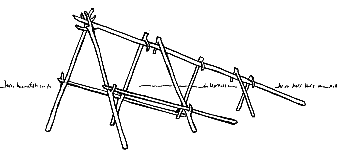
4.
A lean-to made with poles or fallen trees and a covering
of plastic, boughs, thick grasses or bark is effective
to shelter you from wind, rain and snow.
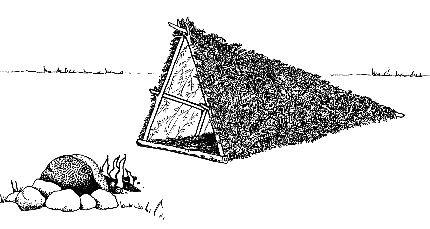
5.
A wigwam may be constructed using three long poles.
Tie the tops of the poles together and upright them
in an appropriate spot. Cover the sides with a tarp,
boughs, raingear or other suitable materials. Build
a fire in the center of the wigwam, making a draft
channel in the wall and a small hole in the top to
allow smoke to escape.

6.
If you find yourself in open terrain, a snow cave
will provide good shelter. Find a drift and burrow
a tunnel into the side for about 60 cm (24 in) then
build your chamber. The entrance of the tunnel should
lead to the lowest level of you chamber where the
cooking and storage of equipment will be. A minimum
of two ventilating holes are necessary, preferably
one in the roof and one in the door.
 CLOTHING
AND EQUIPMENT CLOTHING
AND EQUIPMENT
Clothing
Clothing must provide warmth and offer
protection from the elements. Layers of light, natural
fibers are best. Hats are a must, as they offer protection
from both the heat and cold. Water proof outer layers
are necessary.
Equipment
Equipment must be easily manageable and
promote survival in any situation. Items to carry
in your pockets may include a fire starter, waterproof
matches and/or lighter, a pocket knife, goggles, compass,
small first-aid kit and some sort of trail food.
Survival
Kit
Items for your survival kit should be packed
in a waterproof container that can double as a cooking
pot and water receptacle and be attached to your belt.
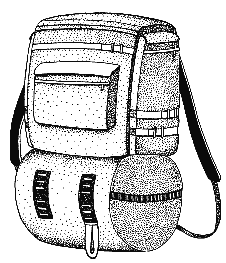
Backpack
In addition to a survival kit, a good,
comfortable backpack is mandatory. Loads of about
18 kg (40 lb.) are average. Items to include are;
flashlight, extra jacket, socks and mittens, a pocket
saw, gas camp stove, first aid kit, emergency food,
and a  tent
and fly. tent
and fly.
CHECK
LIST
Useful
items to include on your hike are:
1. A map and compass.
2. A large, bright plastic bag will be useful
as a shelter, signaling device or in lieu of raingear.
3. A flashlight with extra batteries.
 4.
Extra water and food. 4.
Extra water and food.
5. Extra clothing such as raingear, a toque and
gloves, a sweater and pants.
6. Sun protection such as sunglasses, sunscreen,
a hat and long sleeved clothing.
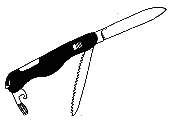
7. A sharp pocket knife.
8. Waterproof matches, a lighter and/or a flint.
 9.
Candles and fire starter. 9.
Candles and fire starter.
10. A first aid kit.
11. A whistle, flares, a tarp.
Before
venturing into the wilderness check weather forecasts
and hazards.
Basic
Survival | Travel
| Food & Water
First Aid & Health
Outdoor
& Survival Training
|